
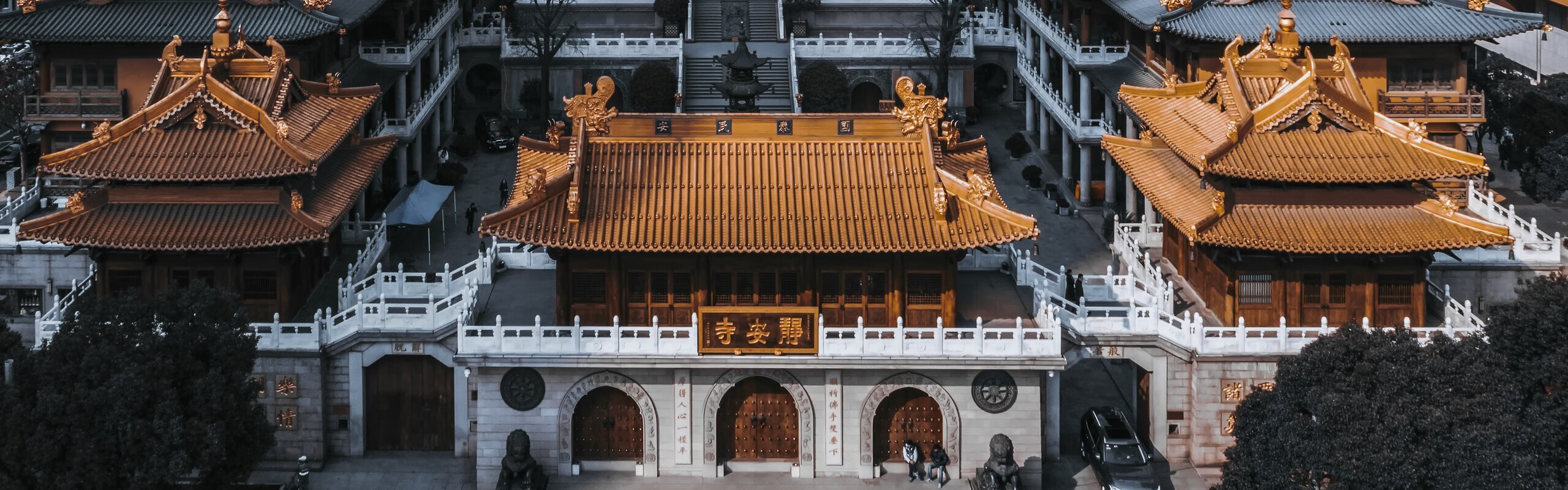

Jing’an Temple is one of Shanghai’s most recognizable contrasts: a gilded Buddhist temple standing amidst a modern city with heavy traffic and beside one of the city’s busiest metro stations.
If you only want Shanghai’s classic temple-and-skyscraper photograph, you do not need to buy a ticket for Jing’an Temple. The exterior, nearby plaza, and surrounding streets already give you the city contrast most visitors come for.
Pay to enter only if you want to see the temple as a working Buddhist site: incense, worshippers, timber halls, and Buddhist statues at close range. That is the real choice to make before you arrive.
Is Jing’an Temple Worth Paying to Enter?

- Opening hours: 7:30–17:00
- Entrance fees: 50 RMB/pp (free admission for seniors aged 70 and over and children under 1.3 meters in height)
- Time needed: 1–2 hours
For a first visit, think of Jing'an Temple in two parts:
Exterior visit: free, flexible, and best for the iconic “golden temple in modern Shanghai” image.
Inside visit: paid admission, active worship spaces, and a closer look at the halls, statues, and ritual atmosphere.
Skip It If You Only Want a Quick Photo
The exterior is enough for a strong photograph. You can frame the golden roof with skyscrapers, moving traffic, or people crossing the plaza, creating a picture that says “Shanghai” rather than simply recording a temple facade.
Three nearby viewpoints work particularly well:
1. The pedestrian overpass at Huashan Road and Yan’an West Road gives you the widest city composition. From above, place the temple in the distance and let the traffic and towers fill the foreground. Use the railing only as a compositional line; do not climb it or obstruct pedestrians.
2. The reflecting pool near Exit 14 of Jing’an Temple Station works best when the water is still. Hold your phone low and include both the gold roof and its reflection. This is a simple, social-media-friendly shot that needs no ticket.
3. Jing’an Temple Plaza is better for a closer family or couple photograph. Step slightly away from the entrance flow, keep the guardian lions or roofline in the frame, and avoid blocking people who are arriving to worship.
For daylight, the temple roof usually reads most clearly when the sky is bright.
For a darker, more cinematic image, arrive around sunset. However, to photograph the temple illuminated at night, you will need to visit between 6:00 PM and 10:00 PM on a Friday or Saturday.
If photography is your priority, a China Highlights guide can place these viewpoints into your walking route instead of sending you inside simply because the temple appears on a standard sightseeing list.
Enter If You Want to See an Active Buddhist Temple
Inside, Jing’an Temple makes sense when you want to understand it as an active Buddhist temple rather than a photogenic building.
You may see people lighting incense, praying, and moving quietly through the halls. Keep your voice low, follow signs and staff instructions, and never photograph worshippers, monks, or sacred objects without permission.
Touring the temple usually takes about one hour for the main spaces. With children, or if you want time to observe the architecture, allow longer. If your Shanghai schedule is already packed, the exterior is the better choice.
- Mahavira Hall
The Mahavira Hall is the main focus of most visits. It houses a colossal silver statue of Sakyamuni Buddha—standing approximately 8.8 meters tall and weighing around 15 tons—which serves as the temple's most prized treasure.
Worshippers come here to pay their respects and pray for their families' safety and well-being, seeking to avert misfortune and clear away life's troubles and obstacles.
- Jade Buddha Hall and Guanyin Hall
The side halls offer a more intimate contrast to the main hall's scale, named for a large white-jade Buddha and a Guanyin statue carved from camphor wood.
These details are best appreciated slowly. Look at the material texture, the expressions on the statues, and the relationship between the statues and the surrounding woodwork.
Worshippers typically visit the Guanyin Hall to pray for harmony in their personal relationships, while seeking physical health and the purification of karmic obstacles at the Jade Buddha Hall.
- Jing'an Vajrasana Pagoda
Located in the northwest corner of the temple complex, this seven-story square pagoda is another important part of the temple’s skyline.
Beyond admiring its architectural beauty, you may also join the faithful in circumambulating the pagoda three times in a clockwise direction to pray for smooth endeavors and family harmony.
Etiquette for Visitors
- Please dress modestly when entering the temple;
- Step over the threshold rather than stepping on it;
- Light incense with your left hand; do not blow out the flame with your mouth—extinguish it by gently waving the stick instead;
- Please speak in a low voice while inside the halls;
- Do not block the pathways leading to the altars or incense burners;
- Do not photograph Buddha statues, monks, or worshippers without permission.
How Long Do You Need at Jing’an Temple?
- 30–45 minutes: exterior views and photography;
- About 1 hour: a basic inside visit covering the main halls and atmosphere;
- 1–2 hours: a slower visit with children, photography, or more time for observation.
Jing’an Temple is close to its metro station, but the practical visit still includes reaching the entrance, dealing with tickets, and moving through a busy area.
Avoid scheduling an inside visit immediately before a timed reservation elsewhere.
How to Fit Jing’an Temple into a Shanghai 1-Day Itinerary
Jing’an Temple works well in a fast-paced route that shows several sides of Shanghai in one day: classical gardens, leafy historic streets, a modern business district, and the Bund after dark.
This itinerary is possible, but it is full. Treat the time suggestions as a framework rather than a promise.
- Morning: Yu Garden and Yu Garden Bazaar (Enter as early as your ticket and opening arrangements allow, then leave time to browse the surrounding lanes and shops.)
- Early afternoon: Wukang Road and Anfu Road (no need to cover every side street. The purpose of this stop is to experience the quieter version of Shanghai.)
- Late afternoon: Jing’an Temple and the Shanghai CBD (Visit the exterior first. If you have checked the day’s ticket information and have at least an hour available, go inside; otherwise, use the plaza and one nearby viewpoint for the temple-and-city contrast.)
- Evening: The Bund at Sunset (This final stop is best kept flexible. Traffic can be slow, and sunset time changes throughout the year. )
This 1-day itinerary gives you a memorable overview of Shanghai, but it does not leave much room for long meals, shopping, or spontaneous stops. If you have 2 or more days in Shanghai, it is better to spread these areas across a slower private itinerary.
A China Highlights travel advisor can help separate the old city, Former French Concession neighborhoods, Jing’an and the Bund into a route with more time for meals, rest and local experiences.