
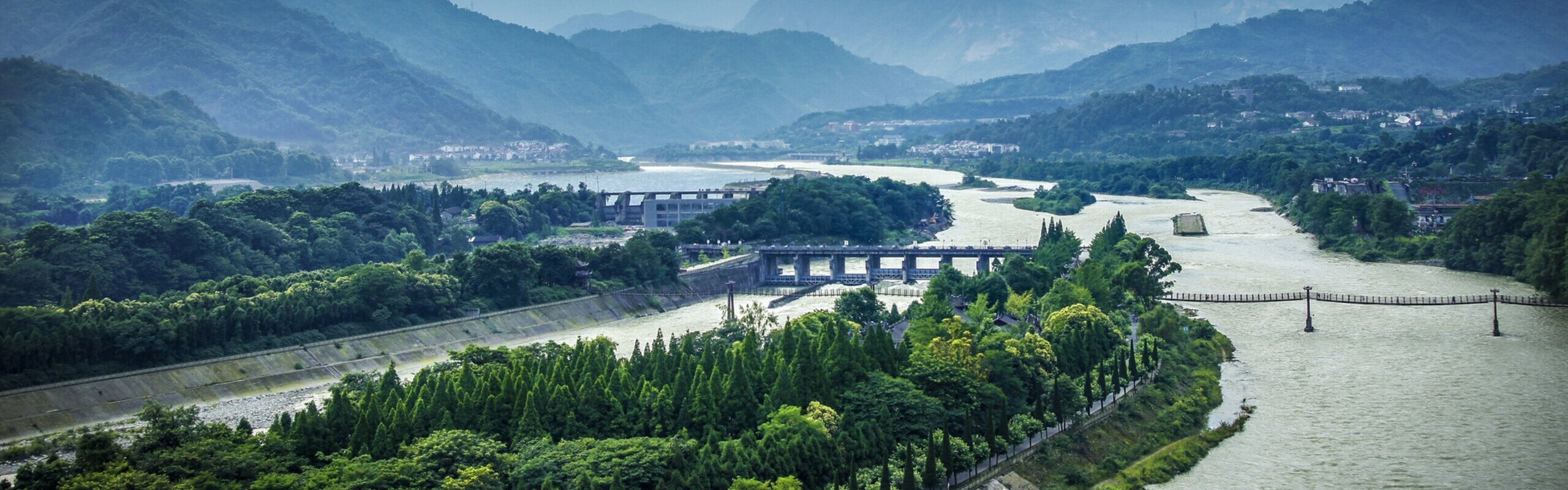

Dujiangyan is worth adding a half-day visit. You can witness a 2,000-year-old water system still working today. But don't follow the usual Gate 1 route, or you may spend more your energy walking uphill instead of understanding the irrigation project.
Based on my own visit, here are the practical tips to help you avoid common mistakes and make the most of your time.
Do You Need a Guide to Understand Dujiangyan?
You can search for how Dujiangyan works before or during your visit, such as on Red Note or YouTube. However, I still recommend having a guide explain it on-site.
You'll not only hear the guide share with you about Fish Mouth, Flying Sand Weir, and Baopingkou. Also, you'll discover the stories of the builders, such as Li Bing and his son, the workers who built the irrigation system, and the ancient nanmu trees inside the scenic area.
Start Your Visit From Qinyan Tower, not South Gate

Recommended Route: Qinyan Tower (Gate 6) → Anlan Cable Bridge → Fish Mouth → Flying Sand Weir → Fulong Temple (Baopingkou) → Exit from South Gate (Gate 1)
This downhill route takes 2h and saves your energy. It's best if you don't want uphill climbing or are traveling with seniors and kids.
1. Qinyan Tower: Overlook Dujiangyan Before You Walk Into It
Starting from here gives you the best introduction.
You first see the whole irrigation system and understand how the Min River is first divided here into the inner and outer rivers, and how these two rivers work in different seasons.
There is also a small model display and an audio-visual explanation with English subtitles, which is useful if you want a quick introduction before exploring.
2. Anlan Cable Bridge: Be Careful When You Walk Through It
You can easily lose your balance when you walk through this shaky three-section suspension bridge.
Hold the ropes on both sides for safety or walk in the middle (more stable).
During peak seasons, you may queue for 1h to cross the bridge. If you want to avoid long queues, try to arrive before 9:00 am.
3. Fish Mouth: Stand on the Viewing Platform to See Min River
When you stand on the Fish Mouth, it is hard to imagine that this structure was created with more than 8,000 bamboo cages filled with stones, each weighing around 150 kg (330 lbs).
You can take the shuttle bus here to Flying Sand Weir. It saves you 1km walking and only costs CNY 10, but you typically need to queue 20-60min during peak season.
If you don't want the long queues, consider walking 15min instead. Along the way, it's all shady, so you'll still feel cool in summer.
4. Flying Sand Weir: Take a Shuttle Bus to Get There
It helps control floods and sediment. When standing on the riverside, you can see the layers of sediment collected along the edge.
If you come during the flood season from June to September, especially after the rain, standing on the bridge, you can directly see how the Flying Sand Weir "throws" the sand from the inner river to the outer river.
5. Fulong Temple: You Need 5-10min Uphill Walking
It's the best spot to overlook Flying Sand Weir and see Baopingkou more closely. You will see and learn how the irrigation water is diverted from here to the Chengdu Plain.
If you visit in July or August, remember to look up. You'll find a beautiful view framed by traditional grey-tiled roofs on both sides and blooming crape myrtle trees in the middle, with the sky in the background.
Why We Don't Recommend the Full Route for First-Timers
A complete visit can take 3–4h and includes places like Songmao Ancient Trail, Yulei Pavilion, and Erwang Temple.
For first-time visitors, these areas add walking time but do not significantly improve your understanding of the irrigation system.
- Songmao Ancient Trail: It looks wild and beautiful, but with lots of Urtica leaves. If your skin accidentally touches it, it will hurt a lot. And you may also encounter snakes on the trail.
- Yulei Pavilion: you'll get a different panoramic view. But you also need extra climbing.
- Erwang Temple: also a Taoist temple like Fulong Temple, not so special to see
Don't Visit Dujiangyan Only for the Blue Tears
If you are interested in photography, the night view can be a nice addition.
But if your goal is to understand the irrigation system, visit during the daytime, because the Blue Tears are located outside the irrigation system scenic area. You won't see the key structures like Fish Mouth and Flying Sand Weir at night.
Also, keep in mind that the blue glow is created by lighting effects, not natural bioluminescence.
When I visited, the water looked green to my eyes. My phone captured a greener color, but my camera showed a more blue tone. So the final color can vary depending on your device.
What Time Do the Blue Tears Lights Turn on?
| Season | Light up | Light off |
|---|---|---|
| April to October | Around 7:00–8:00 pm | 11:00 pm |
| November to March | Around 5:30–6:40 pm | 11:00 pm |
For the best photography effect, we suggest going after 8:30 pm in summer and 7 pm in winter, when the sky is completely dark.
Where to See the Blue Tears Night View?
The best route is: Tianfuyuan Corridor Bridge → Nan Bridge → Guanxian Ancient Town
I prefer Tianfuyuan Corridor Bridge cause there is a pathway in the middle of the water channel, and you can stand closer to the water and capture the glowing river. And it's less crowded.
Nanqiao Bridge looks more exquisitely designed, where you can capture dragon head decorations over the illuminated water.
However, it's the most crowded spot, even when we visited in the off-season in March. When you squeeze through the crowd to take photos, be careful not to fall off.
Guanxian Ancient Town connects directly to Nanqiao Bridge. To be honest, it's commercial. But if you still want some walking at night, it's a good choice to taste some Sichuan snacks.
Visit around 8- 9 a.m. or after 4 pm to Avoid Crowds
Many travelers visit Dujiangyan after visiting a panda base, because they want to see active pandas in the morning. As a result, the irrigation system is often busier in the afternoon.
If you also arrange your itinerary like this, avoid weekends, July and August, and some public holidays like May 1-5 and Oct 1-7, or enter at 4 pm. There are still 2h for you to explore before it closes at 6 pm in summer.
If you do not have a morning panda schedule, entering around 8-9 a.m. is the best choice.
What Season Is Best for Dujiangyan?
April-May and September-November are the best months for comfortable walking, with mild weather and fewer crowds. You'll rarely need to wait in lines.
However, if you are looking for specific seasonal scenery or activities, I would recommend:
| Flower or Autumn Leaves | March August November |
March: Pink begonias blooming around Nanqiao Bridge. August: 500-year-old crape myrtle flowers at Fulong Temple. November: Golden ginkgo avenue near Fish Mouth. |
| River Colors and Flow | February-April (dry season) July-August (flood season) |
During the dry season, you'll see some exposed riverbank. During the flood season, you can witness the spectacular water release at Flying Sand Weir, though sometimes the river is muddy or yellow-green |
| The Water Worship Ceremony | April, around Qingming Festival | Grand ceremonies with rituals like Hanfu costumes, water release celebrations, and praying |
One thing to keep in mind: fog is common on cloudy days, which may limit your views from Yulei Pavilion and Qinyan Tower. If you arrive on a cloudy morning, consider visiting around noon or in the afternoon when visibility may improve.
How to Get From Chengdu to Dujiangyan
Option 1: Private Car is the Most Comfortable
Your driver can pick you up directly from your Chengdu hotel and take you to Qinyan Tower Gate 6, the best starting point for the recommended route. The drive takes around 1.5h.
With a private guide joining you, you won't need to figure out transfers, entrances, or the best walking direction on your own. This is especially helpful if you also want to combine other attractions like Dujiangyan Panda Base.
Option 2: Public Transport, Cheaper, but Need Transfer
By metro: Take Metro Line 2 or Line 6 to Xipu Station, then transfer to an intercity train to Lidui Park Station (around 30 minutes). From there, it's about a 5-minute walk to Gate 1.
By direct shuttle bus: you can get on the bus from Chunxi Road (under the IFS climbing panda statue) or Wide and Narrow Alleys. It usually runs less frequently, so you need to wait. The drop-off spot is also near Gate 1.
You'll notice that the public transport only takes you to Gate 1. That's why many first-timers will start here and unknowingly walk uphill for most of the route.
If you want to take the metro or shuttle bus, you can take a taxi or bike to Qinyan Tower in about 15min. But for families with seniors or children, a private car can save you more transfer time.
What Else Can I Visit Near the Dujiangyan Irrigation System?
| Attractions | What you expect | From Dujiangyan |
|---|---|---|
| Dujiangyan Panda Base | Pandas, cubs, volunteer program | 30min |
| Panda Valley | Giant pandas and red pandas | 10min |
| Qingcheng Mountain | Taoist culture and mountain hiking | 30min |
| Zhongshuge Bookstore | A Harry Potter-style bookstore, best for photos | 15min |
| Yangtianwo Square | An iconic landmark, with a giant panda taking a selfie sculpture | 10min |
If you want to combine pandas, Dujiangyan, and Qingcheng Mountain without backtracking, we can arrange a private day trip based on your pace.
- Day 1: Pandas, Dujiangyan Irrigation System, Zhongshuge and Yangtianwo Square
- Day 2: Qingcheng Mountain (visit the front mountain or back mountain)
How to Combine Dujiangyan with a Chengdu Itinerary?
- Day 1 in Chengdu: Arrive in Chengdu, visit Chunxi Road and IFS Panda Climbing Wall
- Day 2 in Chengdu: Chengdu Panda Base, People's Park, Wide and Narrow Alleys, and Sichuan Opera with a face-changing show
- Day 3 in Dujiangyan: Dujiangyan Irrigation System, Zhongshuge, Yangtianwo Square, return to Chengdu in the afternoon, and visit Eastern Suburb Memory
- Day 4 in Emei: Visit Mount Emei, such as the Golden Summit
- Day 5 in Leshan: Visit the Giant Buddha, explore Leshan snacks, departure
Or if you also want to visit Jiuzhaigou, you can consider our 6-Day Songpan, Jiuzhaigou and Dujiangyan Tour.